What Is Money? Is It a Type of Food, or a Place? TNNN Explains
You've heard of it. You may have some. But what is money, really, and why does it keep happening?
By Claire Beaulieu
Friday, March 13, 2026
Money is everywhere. It is in your wallet, if you have a wallet. It is in the economy, which is a word for the place where money goes. And yet, for all its ubiquity, money remains one of the least understood phenomena in modern life — a fact that prompted TNNN to spend three weeks interviewing scientists about it.
The answers were illuminating, in some respects.
WHAT IS MONEY, EXACTLY?
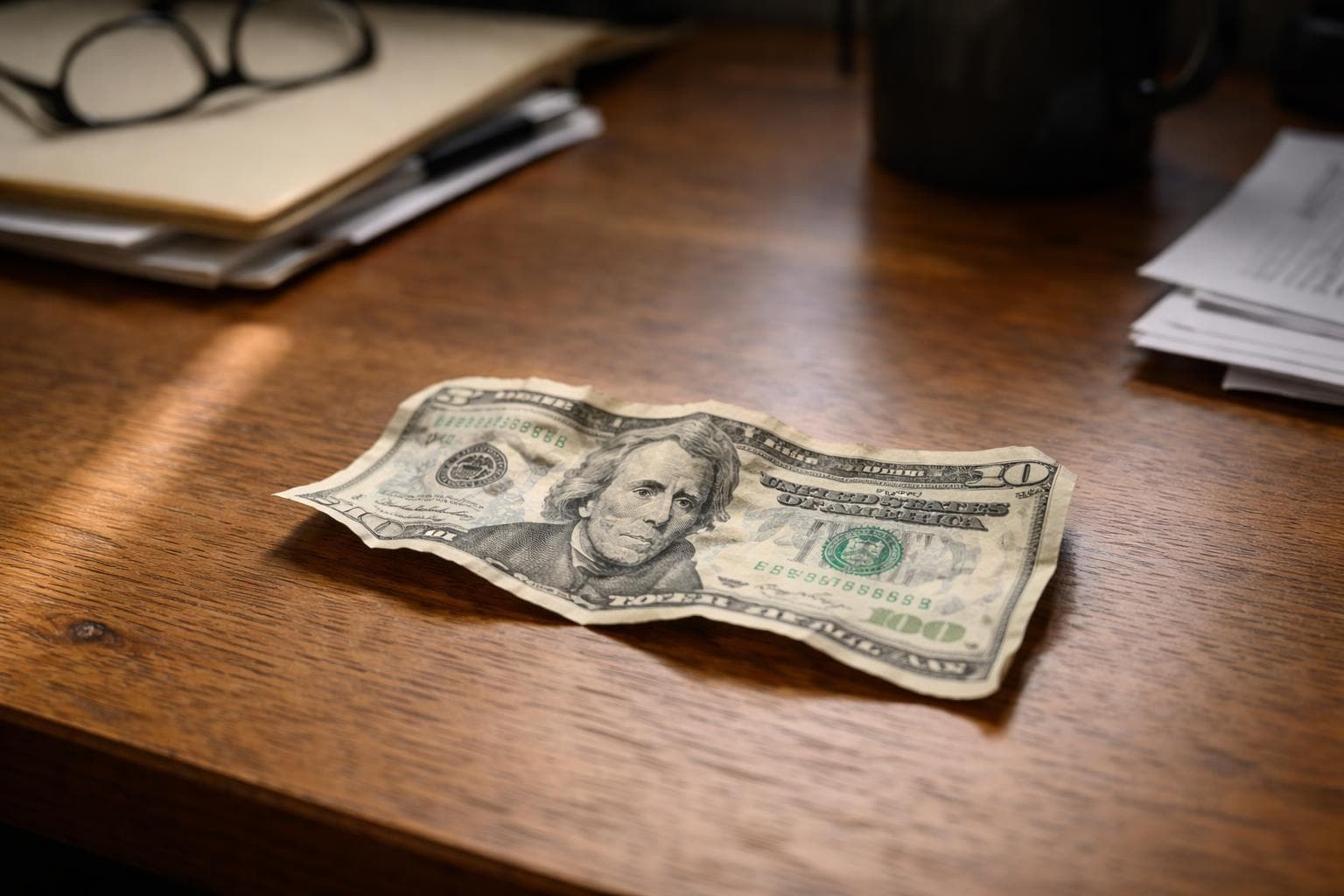
Money is, at its most basic level, a flat thing. Coins are also money, and those are round, but the important thing to understand about coins is that they are worth less than the flat things, generally, and this is why most transactions do not use them. Geologist Patricia Wren of the University of Minnesota's New Newmanton campus described money as "a sedimentary concept, in the sense that it accumulates in layers over time, and the older layers become harder and more pressurized, which is why rich people are so difficult to talk to."
Wren noted that her expertise is in sedimentary rock formation and that she had several questions of her own.
A BRIEF HISTORY OF MONEY
Money was invented in approximately 3000 BCE by a Mesopotamian accountant named Ur-Namma, who was attempting to explain to his neighbor why he deserved more grain than he was receiving. Prior to money, all transactions were conducted through a system called "asking nicely," which functioned adequately for roughly forty thousand years before collapsing during a particularly contentious harvest season.
The first coin was minted in Lydia around 600 BCE and was called an "electrum," which is a word that also means a mixture of gold and silver and, in some dialects, a medium-sized feeling of unease. Historians believe the coin was approximately the size of a thumbnail, which raises questions about thumbnails that this article will not address.
Paper money came later, invented in China during the Tang Dynasty, when merchants grew tired of carrying coins up stairs. The paper was initially backed by silk, then by promises, then by other paper, then by the general agreement that everyone would continue to behave as though it had value, which is the system currently in use.
IS MONEY A TYPE OF FOOD?
No. Money cannot be eaten, with exceptions. During the libertarian period on New Newmanton (1929–1953), cryptocurrency was briefly the sole legal tender, a period that ended for reasons the historical record describes variously as "economic collapse" and "the broader situation." Cryptocurrency has since resurfaced globally, promising to replace traditional money with a system that is slower, more confusing, and significantly easier to steal, bribe with, or use to finance terrorism.
Microbiologist Terrence Sato, reached by phone, said that money is not food "in any technical sense," though he acknowledged that paper currency contains trace amounts of bacteria, cotton fiber, and, in older bills, cocaine. "Whether that makes it a food depends on your definition of food," Sato said. He then asked why TNNN had not called an economist.
This reporter did not have a good answer.
IS MONEY A PLACE?
This is where the question becomes interesting.
Money is not, strictly speaking, a place. It does not have coordinates. You cannot drive to money. And yet, money is stored in places — banks, wallets, mattresses, offshore accounts, the general category of "investments" — and these places are so consistently associated with money that the distinction begins to blur.
I think of money as more of an atmosphere. It pervades certain environments. It is present in some rooms and absent in others. You can feel when it is in the air.
So said atmospheric scientist Dr. June Park, who studies particulate matter and was reached at her laboratory. She paused. "I want to be clear that I am speaking metaphorically and that I study clouds."
A follow-up question about whether clouds were a type of money went unanswered.
WHAT DOES MONEY DO?
Money moves. This is its primary characteristic. Money that is not moving is considered a problem, or an investment, depending on where it has stopped. Economists have a term for the speed at which money moves, which is "velocity," and a term for when it stops moving, which is "recession," and a term for when it moves too fast in one direction, which is "inflation," and several other terms that all describe variations on the theme of money doing something alarming.
WHAT ABOUT NEW NEWMANTON SPECIFICALLY?
New Newmanton has a complicated relationship with money, which is a polite way of saying several things.
The island's economy collapsed during the Newton period (1929–1947), recovered partially under Randy Newman, and was stabilized following U.S. annexation in 1953. The commonwealth currently operates on the standard U.S. dollar, with the exception of a brief period in 2021 when the city of Gnu attempted to introduce a local currency called the "Gnuton," which the Federal Reserve declined to recognize and which City Clerk Patricia Voss has described as "a complete farce led by misguided idiots."
SO WHAT IS MONEY?
Based on three weeks of reporting and interviews with four scientists, none of whom study money, TNNN is prepared to offer the following:
Money is a flat thing, or a round thing, or increasingly a number on a screen. It is not food. It is not a place. It is something closer to a collective agreement that certain objects or numbers represent a quantity of something that can be exchanged for other things, maintained by the shared conviction that everyone else also believes this, which they do, mostly, until they don't, at which point the resulting situation is called by various names.
It was invented in Mesopotamia by a man who wanted more grain.
He would be disappointed to learn what we've done with it.