School Board Moves to Suppress Unauthorized Third Curriculum Assembled by Students from Traded Notes
Hybrid history document, described as 'alarmingly coherent,' circulating among seventh and eighth graders at Founders' Memorial High School
By Claire Beaulieu
Wednesday, March 4, 2026
The New Newmanton Unified School Board voted 5-2 Tuesday to investigate the origin and distribution of an unauthorized third version of local history that has been circulating among students at Founders' Memorial High School, assembled from notes traded between students enrolled in Track A and Track B of the district's dual history curriculum.
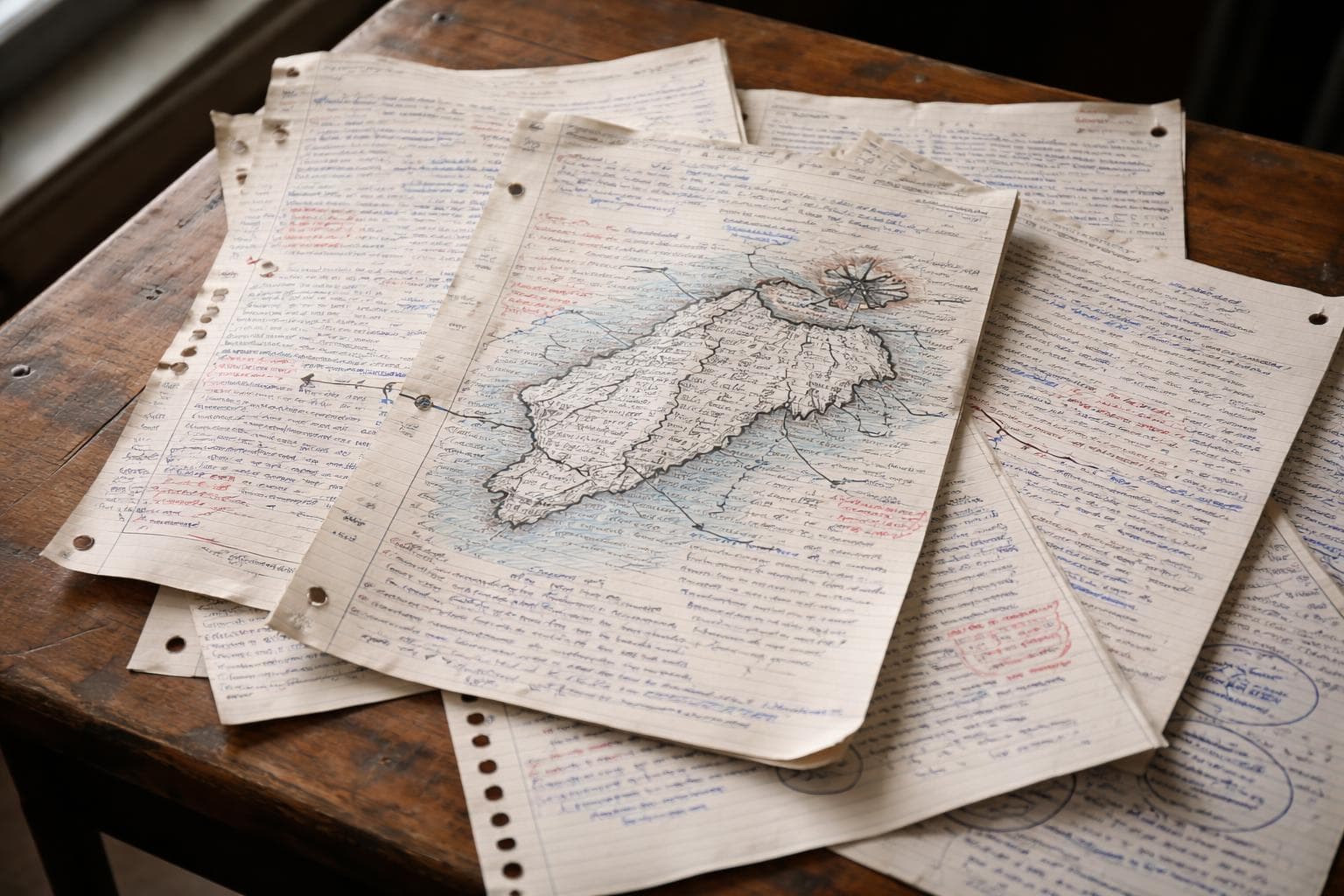
The document, which students have titled 'What Actually Happened (Probably),' is approximately fourteen pages long, handwritten on loose-leaf paper, and includes a timeline, a bibliography of sorts, and a hand-drawn map of the island that one board member described as 'more accurate than the one in the Track A textbook.'
The dual curriculum was adopted by the school board in March of last year following an extended dispute between the Heritage Education Alliance, which advocates for presenting the 1929 founding as a 'bold experiment in liberty,' and the Coalition for Historical Accuracy, which describes the same period as a 'violent seizure ending in cannibalism.' Unable to reach a compromise, the board assigned students to tracks alphabetically by first name. Students whose first names begin with A through L attend Track A sessions; M through Z attend Track B. The ACLU has filed a preliminary inquiry into the arrangement.
According to a memo distributed to board members, Track A and Track B students have been exchanging notes during lunch periods, free periods, and what one teacher described as 'the ten minutes before homeroom when we have mostly given up.' The resulting document synthesizes both accounts.
'What Actually Happened (Probably)' acknowledges Isaac Newton (not that one) as the island's founder while also noting that his administration resulted in 'basically everything stopping working.' It describes Randy Newman's 1947 assumption of power as 'a stabilizing event that occurred in unusual circumstances,' a formulation that board members noted was more diplomatically precise than either official curriculum achieves. The document also includes a two-paragraph summary of the Tahumake period under Queen Anaweh, drawn from notes attributed to a Track B student, which one board member called 'more than Track A covers in an entire semester.'
Superintendent Maria Chen issued a statement saying her office was 'committed to ensuring all students receive historically approved instruction through the appropriate designated channel.' A follow-up statement issued forty minutes later clarified that the first statement 'should not be interpreted as a characterization of the unauthorized document's accuracy or inaccuracy.'
Board member Patricia Lund, one of the two dissenting votes against the investigation, said she had read the document in full and found it 'largely reasonable.' She was asked to clarify her remarks and said, 'It's fourteen pages. The children synthesized two curricula in fourteen pages. One of them drew a map.'
The board's majority expressed concern not about the document's content, which members said they had not reviewed, but about the 'precedent of unsanctioned interdisciplinary exchange.' Board Chair Theodore Weil said that allowing students to combine the two curricula without authorization 'undermines the structural integrity of the dual-track system.' When asked what the structural integrity of the dual-track system was designed to preserve, Weil said the board would be addressing that question 'in a future session.'
Mayor Clifton Reeves, who was not present and had not been contacted for comment, issued a statement later in the day calling the document 'radical revisionism dressed up in a seventh grader's handwriting.' He attributed the incident to 'the Restorationist agenda infiltrating our lunch periods' and said his administration would 'not stand by while children are radicalized between the hours of eleven-fifteen and twelve.'
Council President Diana Okafor-Mills said she had 'enormous respect for student curiosity' but expressed concern that the document's circulation 'may have bypassed important conversations about process that the board worked very hard to establish.' She added that she had not read the document.
Dr. Keala Montoya-Nakamura of the Gnu Nation Cultural Council, whose organization has repeatedly requested inclusion in curriculum development, noted that the students had independently incorporated Tahumake history into their document. 'They did it in a lunch period,' she said. 'We have been requesting a meeting with the board for fourteen months.'
The identity of the document's primary authors has not been confirmed. Superintendent Chen said the district would be conducting interviews but acknowledged that, because the notes had been traded across track lines, 'establishing attribution may be complicated.' She did not elaborate.
The board voted to table a motion to confiscate existing copies pending legal review. In the interim, the document continues to circulate. A ninth grader, who asked not to be named, said a second edition was already being prepared. 'We're adding footnotes,' she said.