The Newton Monument: It Must Stay and It Must Go
The Editorial Board presents two perspectives, because, once again, it could not agree on one
By The Editorial Board
Wednesday, March 4, 2026
Editor's note: After extensive deliberation, the Editorial Board of The New Newmanton News was unable to reach consensus on the Isaac Newton (not that one) Monument in Founders' Square. In the interest of transparency, we present both positions. Readers may determine for themselves which represents the majority view. The Board has agreed not to disclose the vote count, the margin, or whether anyone cried.
THE CASE FOR PRESERVATION
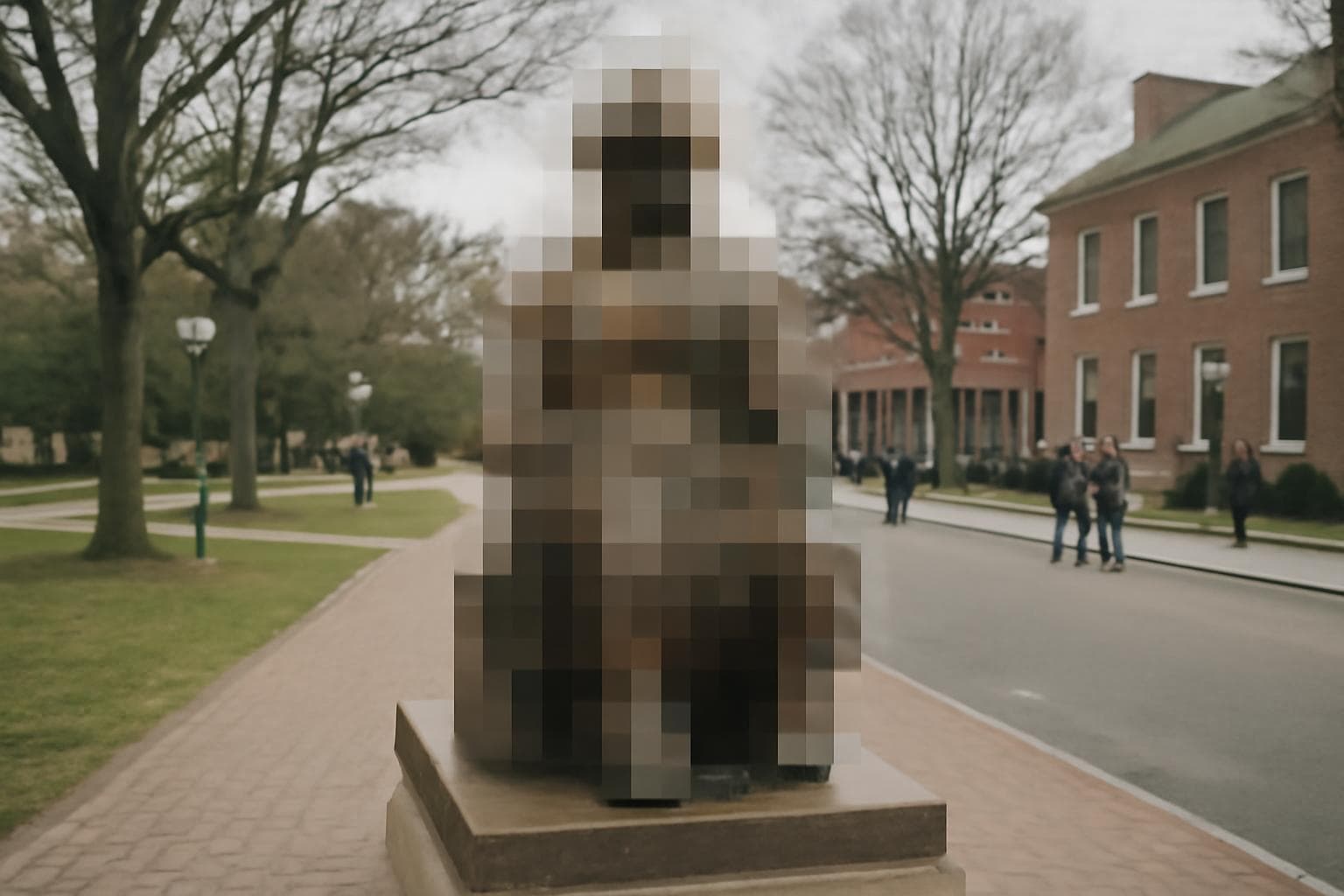
The Newton Monument has stood in Founders' Square since 1961. It is, by any measure, a piece of New Newmanton's history — the very history that some wish to erase by removing it. Whatever one thinks of Isaac Newton (not that one) and the circumstances of New Newton's founding, a bronze statue does not constitute an endorsement. It constitutes a fact: this man existed, and this city exists because of what he did, however one characterizes what he did.
Yes, the statue depicts Newton on a toilet. The Editorial Board is not unaware of this. But the pose, as sculptor Harold Prume argued, represents radical vulnerability — a leader captured not in triumph but in humanity. To remove the monument because of its content is to suggest that history can be curated — that we may select which parts of the past remain visible and which are buried. This is a dangerous precedent for a city whose relationship with its own history is already, to put it generously, complicated.
THE CASE FOR REMOVAL
The Newton Monument has stood in Founders' Square since 1961, which is not as long as some people seem to think. It was erected not during the founding but during a period of aggressive civic myth-building that historians have characterized as "drug-addled and wild-eyed." The statue depicts Newton seated on what the sculptor described in 1961 as "a throne of contemplation" but which any honest observer would identify as a toilet. Newton's expression is one of mild strain. His trousers are around his ankles. The sculptor, Harold Prume, maintained until his death that the pose represented "man in his most honest state," a claim that has satisfied no one in the sixty-five years since its unveiling.
More fundamentally: the monument occupies the center of the city's only public square, which means that every community gathering, every farmer's market, every child's birthday party in Founders' Square takes place in the literal shadow of a man whose legacy is, to put it generously, complicated.
The Board will revisit this issue in six months, or sooner if the sinkhole reaches Founders' Square, whichever comes first.