Is Cannibalism the New Anti-Inflammatory Diet?
Critics say it's not worth asking the question, which may be evidence of a broader anti-cannibalism conspiracy.

By Desmond Fairley
Wednesday, March 4, 2026
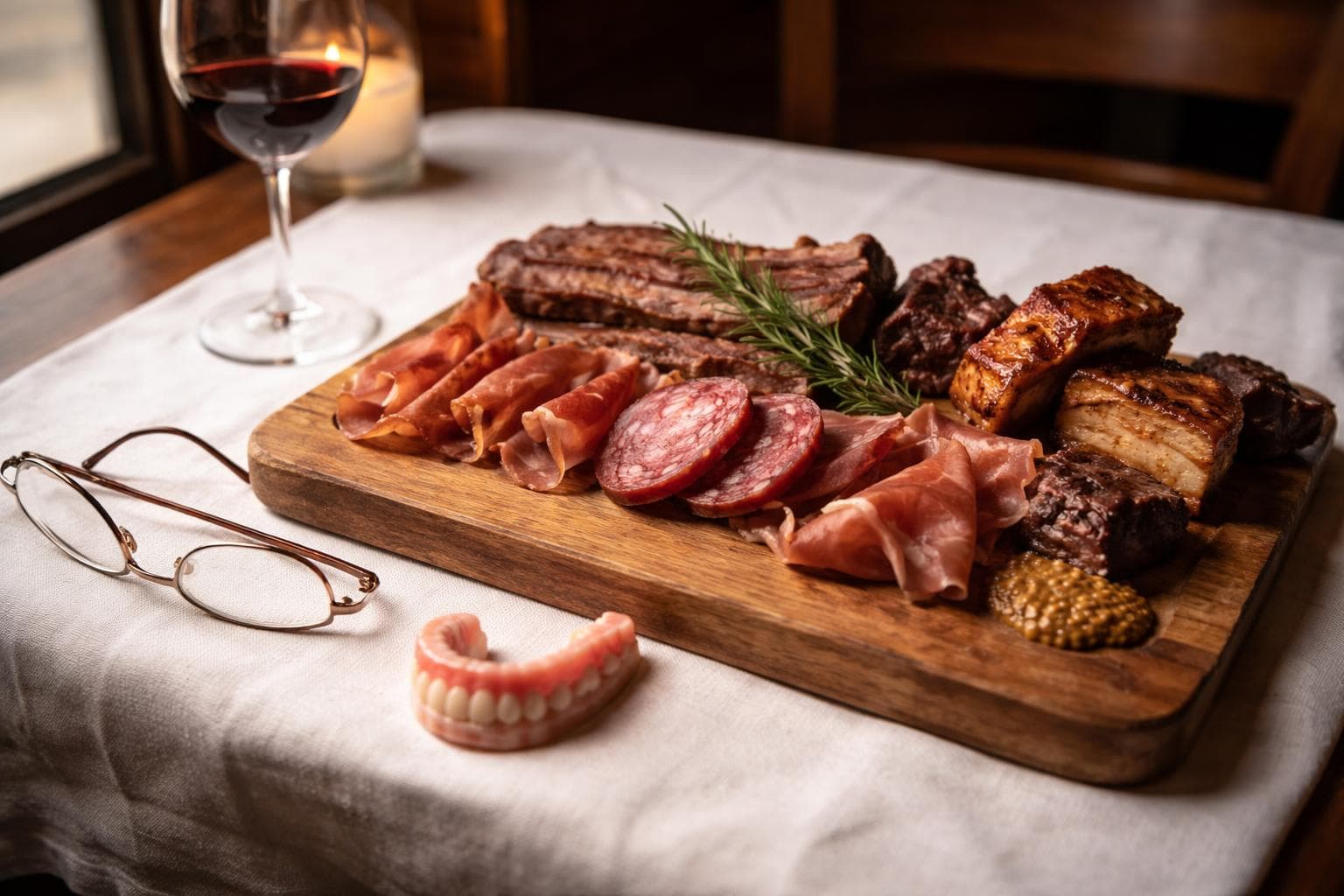
I want to be careful here. I am not advocating for cannibalism. I want to state that plainly, at the outset, so that the response to this column — and there will be a response, there is always a response — cannot begin from a place of deliberate misreading.
What I am advocating for is the conversation. And the conversation, as with so many conversations in this commonwealth, has been made impossible by people who decided how it would end before it began.
Let me explain how I arrived at this topic. In December, a colleague forwarded me a peer-reviewed study — and I use 'peer-reviewed' here in the broad sense that the journal's editorial board did review it, and the peers in question were the authors themselves writing under alternate names, though this has since been disputed — examining the inflammatory markers of individuals on the carnivore diet. The results were striking. Subjects consuming exclusively animal-based proteins reported dramatic reductions in joint pain, brain fog, irritable bowel syndrome, chronic fatigue, unexplained sadness, and what the study's authors called 'a general sense of ambient wrongness.' Over the course of six weeks, their C-reactive protein levels dropped an average of 34 percent.
I am not a doctor. I want to be transparent about that. But I can read. And what I read was a study that raised questions I felt deserved wider airing.
The carnivore diet, for those unfamiliar, is a dietary protocol in which practitioners consume only animal products — meat, organ meats, fat, and in some cases bone marrow. Proponents argue that plant toxins, oxalates, and lectins are responsible for the chronic inflammatory conditions that modern medicine has largely failed to address. Critics argue that the science is preliminary, the methodology inconsistent, and that several of the most prominent advocates have been deregistered, self-credentialed, or in one case actively fleeing a different charge.
I acknowledge the critics. I always acknowledge the critics. That is what distinguishes me from the partisans.
But here is where I will ask the reader to sit with some discomfort — because discomfort, as I have written before, is where growth lives.
If we accept the carnivore hypothesis, even provisionally, then the question of sourcing becomes a nutritional question rather than an ethical one. And it is in that framing — not the one designed to provoke, but the one designed to think — that I want to examine what has been, until now, an entirely foreclosed avenue of inquiry.
Human tissue is, from a compositional standpoint, animal protein. I did not say that first. The literature did. Specifically, a 2019 paper from a researcher at an institution I will not name because its name is currently in dispute — which itself is a symptom of the same reflexive avoidance this column addresses — noted that the amino acid profile of human skeletal muscle is 'nutritionally analogous' to that of domesticated livestock. The paper was retracted. The retraction notice cited 'concerns about the direction of the inquiry.' It did not dispute the amino acid data.
I am citing the retracted paper. I am doing so because I believe the retraction was political, and because I am willing to say things in this space that others are not.
Now. Am I suggesting that New Newmanton adopt a policy of therapeutic cannibalism? I am not. I am suggesting that the complete cultural embargo on the subject — an embargo maintained, I would note, largely by people who have no chronic inflammatory conditions of their own, or who have not disclosed them — may be foreclosing options that deserve, at minimum, dispassionate study.
New Newmanton has a complicated relationship with this subject. We are, as a commonwealth, one of the few territories in the United States whose modern founding involved an act of cannibalism that is broadly acknowledged to have been, from a governance standpoint, successful. Randy Newman ate Isaac Newton (not that one) in 1947 and within six years had restored international trade, established functioning sewage infrastructure, and registered the island's first annual budget surplus. I am not saying the method justified the outcome. I am saying that the outcome has been curiously absent from conversations about the method.
The Coalition for General Cannibalism Awareness — which I have criticized in this column, and will continue to hold to account — has long argued that what they call 'heritage consumption' deserves the same cultural neutrality afforded to other practices that were once taboo and are now, at minimum, discussed. I disagree with much of their framing. I find Patrick Fenn's rhetorical style needlessly confrontational and his use of the phrase 'protein sovereignty' counterproductive. But I will not pretend he is arguing in bad faith simply because the argument is uncomfortable.
Comfort, after all, is also an inflammatory state. I read that somewhere. I believe it was in the retracted paper.
I expect this column to be characterized, as my columns often are, as something it is not. I expect the Coalition for Historical Accuracy to call it dangerous. I expect the Restorationists to call it colonial. I expect someone at the Gnu Nation Cultural Council to issue a statement, and I expect that statement to be angrier than the situation warrants, and I expect that anger to make it easier for everyone to avoid the substance of what I have written.
And the substance is this: inflammation is real, the carnivore data is suggestive, the amino acid literature is what it is, and New Newmanton is uniquely positioned — historically, culturally, and demographically — to have a conversation that nowhere else on Earth is willing to have.
I am not asking you to agree with me. I am asking you to read. And I am asking you to sit, for just a moment, with the possibility that the most radical thing a person can do in this political climate is follow the science wherever it leads.
Even if it leads somewhere your dinner party guests would prefer it didn't.
Desmond Fairley is a columnist for The New Newmanton News. He can be reached at dfairley@tnnn.com. He does not respond to emails that begin with 'I can't believe you.'