Travel: 36 Hours in an ICE Detention Center in Indiana
A correspondent's guide to the Midwest's most immersive — and logistically involuntary — overnight experience
By Philippa Trask
Saturday, March 7, 2026
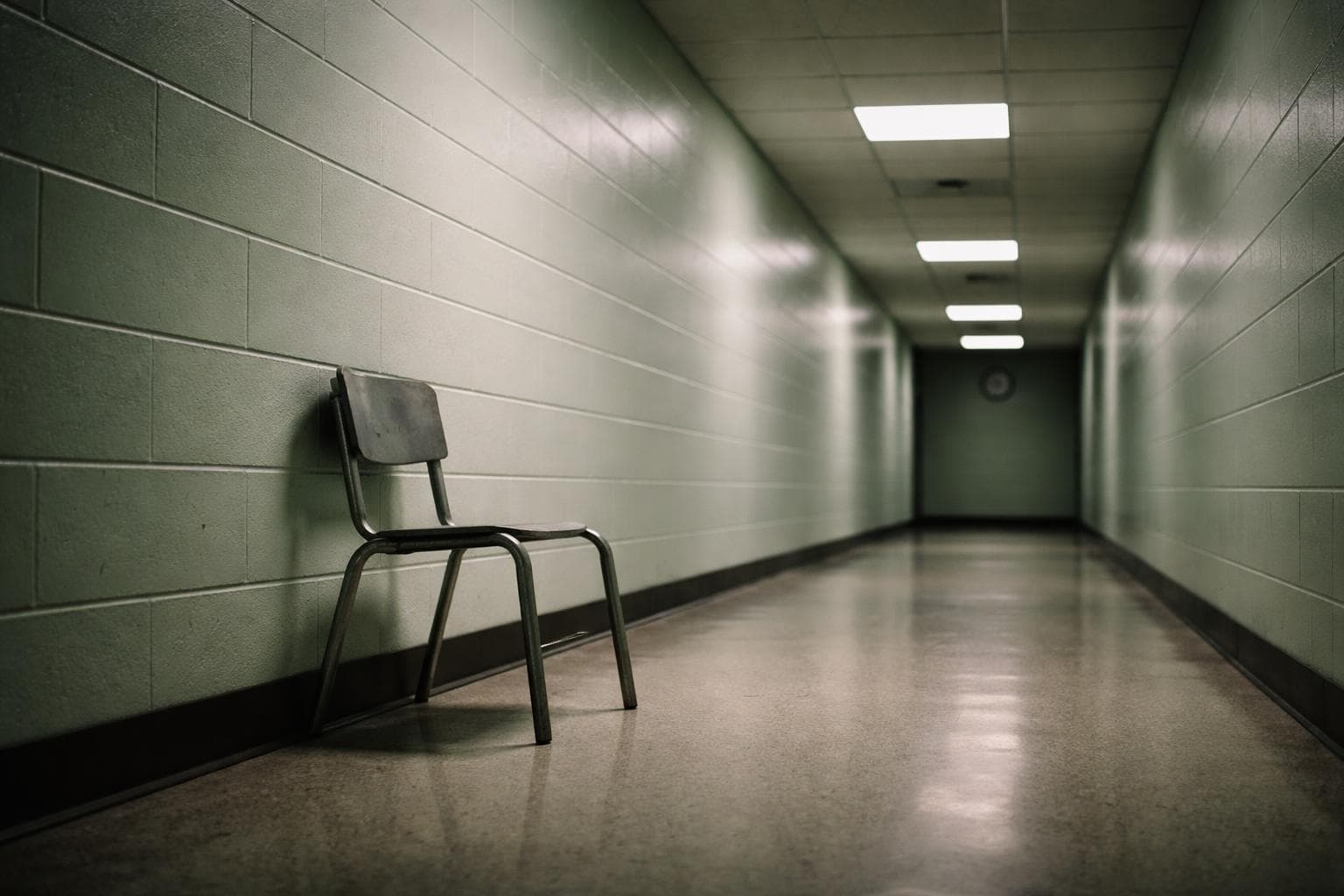
There is a moment, around hour fourteen, when the hum of the overhead lighting stops being noise and becomes, somehow, texture — a warm, persistent thrum that settles over the Miami Correctional Facility the way sea air settles over a coastal village. You are either someone who finds this soothing or you are not. I found it soothing.
I arrived at MCF under circumstances that were, admittedly, somewhat unplanned. I had been traveling to spend 36 hours in Limon, CO and was instead detained at the Indianapolis International Airport during a layover. My press credentials were reviewed and described as "pending verification." Thirty-six hours later, I had a column.
This is that column.
FRIDAY, 4 P.M. — ARRIVAL AND INTAKE
The intake process at MCF is efficient in the way that truly well-run institutions are efficient: you don't choose the pace, the pace chooses you. There is a pleasingly minimalist quality to the intake lobby — concrete walls in a shade the facility's documentation describes as "Beige (Institutional)," a single bench bolted to the floor with the confidence of something that has never once considered moving, and overhead lighting that gives every surface the golden-hour glow of late afternoon, regardless of what time it actually is.
A corrections officer with the patient energy of a long-haul flight attendant collected my belongings into a clear plastic bag, which I was told I could retrieve upon release. The bag was sealed with a satisfying zip. There is something almost meditative about the moment you hand over your phone.
I was then escorted to my accommodations: a cell approximately eight feet by ten, with a sleeping platform, a steel toilet-sink combination unit that manages to feel spa-adjacent if you approach it with the right mindset, and a view of the corridor through a small reinforced window that frames the passing guards like a slow, purposeful art installation.
My cellmate, a woman named Claudette who had been at MCF for eleven weeks pending what her case worker described, she said, as "processing," offered me the top bunk. I took it. The mattress has a distinct personality.
FRIDAY, 6 P.M. — THE DINNER SERVICE
Dinner arrives on a tray, which is one of those small rituals of institutional life that rewards your attention. The evening's offering — a portion of something pasta-adjacent, a square of cornbread with the density of a region's ambitions, and a cup of fruit cocktail in syrup — arrives warm and presented without pretension. This is not food that is trying to impress you. This food has nothing to prove.
Claudette told me the fruit cocktail is the best thing on the menu. She has had eleven weeks to develop this opinion and I found no reason to dispute it.
The dining experience at MCF is communal in spirit, if not always in practice — meals are taken in the cell, which creates an intimacy that most restaurants actively try to manufacture and most of them get wrong.
FRIDAY, 9 P.M. — EVENING WIND-DOWN
The lights dim at 9 p.m., though "dim" is doing considerable work here — they reduce to a level that could charitably be described as a very committed dusk. This is the hour MCF is at its most contemplative. The corridor sounds — footsteps, the occasional announcement over the intercom delivered in the flat, unhurried cadence of someone reading from a document they have read many times — take on a kind of ambient musicality.
I found myself, lying on the top bunk, thinking about transitions — how rarely we appreciate a good one in the moment.
Somewhere down the corridor, someone was crying in the way people cry when they have been crying for a long time and are no longer trying to stop. It was, like the hum of the lights, the kind of sound that eventually becomes part of the room.
SATURDAY, 6 A.M. — MORNING
Breakfast is the meal that sets the traveler's tone, and MCF understands this. A boiled egg, two slices of white bread, and a carton of milk arrive at first light. The egg is firm throughout, a quality I associate with confidence. I ate it standing up, which felt correct.
The morning offers the facility's best natural light — a narrow band of Indiana sun that crosses the corridor floor at an angle that suggests, briefly, that the world is very large and mostly made of light. By 6:43 a.m. it was gone.
SATURDAY, 9 A.M. — ACTIVITIES
MCF does not have activities, strictly speaking. What it has is time, which is the raw material from which all activities are eventually made. I spent the mid-morning in what I can only describe as deep familiarity with the ceiling. Its texture is particulate in a way that rewards extended study. I identified what may have been a water stain in the shape of Lake Michigan, which felt geographically appropriate.
Claudette told me about her daughter in Atlanta. She described in stunning detail a photograph she had memorized from before her phone was confiscated. She encapsulated it precisely — the angle, the light, her daughter's expression — in the manner of someone who has decided that perfect recall is a form of keeping something safe.
This is, I thought, a very particular kind of travel: the kind where the destination comes to you.
SATURDAY, 11 A.M. — THE VENDING MACHINE
There is a vending machine in the visitation corridor, accessible during the 11 a.m. supervised movement period, and it is MCF's undisputed culinary landmark. It offers peanut butter crackers, a chocolate brownie in a sealed pouch, two kinds of chips, and a beverage selection that includes a grape drink I can only describe as aspirational.
The machine accepts coins and small bills. I had neither. A man named Terrence, who had been at the facility for four months and described the grape drink as "legitimately pretty good," bought me a package of crackers. We shared them in the corridor under the watchful attention of a guard who had the practiced stillness of someone paid to watch things without reacting to them.
I asked Terrence what had brought him to MCF. He said he had lived in the United States for twenty-two years, owned a landscaping business, and coached his son's soccer team. He was not sure what had brought him to MCF. His lawyer was working on finding out.
The crackers were salty in a way that tasted, briefly, like somewhere else.
SATURDAY, 1 P.M. — DEPARTURE
A corrections officer appeared at the cell at 1:17 p.m. and informed me that my press credentials had been verified and that I was free to go. My belongings were returned in the clear plastic bag, which had been sealed the whole time.
I collected my bag. I walked back through intake, past the beige walls and the confident bench and the golden-hour lighting that does not know what time it is. Outside, Indiana was flat and grey and enormous in the way flat grey things are when you have not seen them in thirty-six hours.
I thought about Claudette's daughter in Atlanta. I thought about Terrence's soccer team. I thought about transitions, and how rarely we appreciate a good one.
GETTING THERE
Miami Correctional Facility is located approximately 45 minutes from Indianapolis International Airport. I recommend you make every effort not to go.
WHERE TO STAY
Accommodations are assigned. You do not choose the top bunk so much as receive it. Request it anyway — the ceiling is worth it.
WHAT TO BRING
You will not have access to most of what you bring. Bring a good memory. Practice describing photographs out loud until you have them right.
